The Mechanical Engineering Department prepares skilled, ethical, and industry-ready diploma engineers through OBE-based education. With experienced faculty, modern laboratories, workshop training, industrial exposure, projects, Industry 4.0 facilities, and specialized centres for CAD, CNC, Robotics, and Drone Technology, it fosters employability, innovation, sustainability, and lifelong learning.
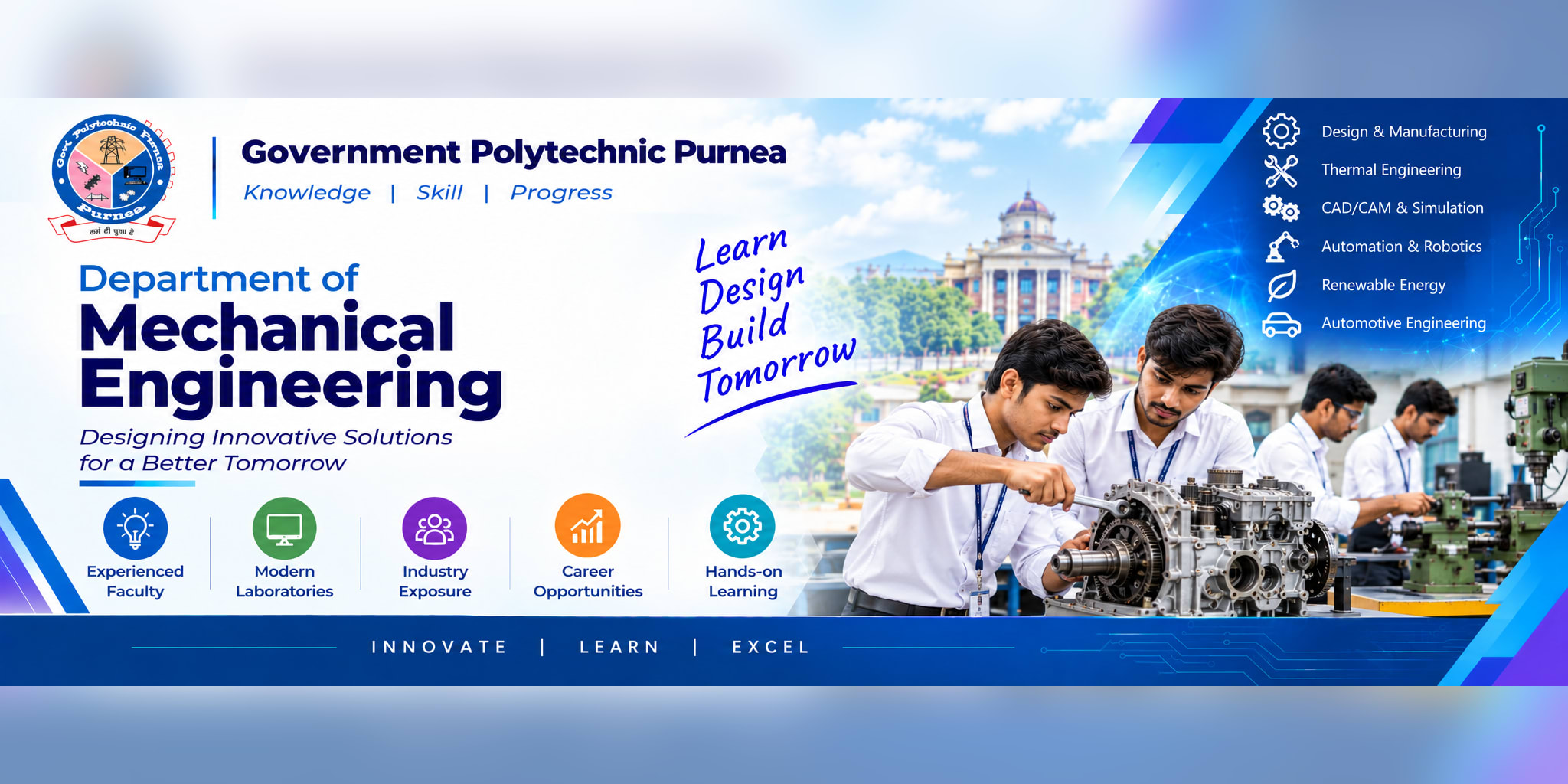
The Department of Mechanical Engineering at Government Polytechnic Purnea is committed to developing technically competent, innovative, and industry-ready diploma mechanical engineers. The department focuses on building strong engineering fundamentals, practical skills, professional ethics, and problem-solving abilities through student-centred and outcome-based education. With a structured learning environment, qualified faculty, laboratory facilities, and practical-oriented instruction, the department prepares students to meet the evolving requirements of industries and society.
The department follows the SBTE Bihar curriculum, integrating classroom teaching with laboratory experiments, workshops, projects, industrial exposure, internships, and field visits. The curriculum covers core areas of mechanical engineering, including:
Engineering Mechanics and Strength of Materials
Manufacturing Engineering and Production Technology
Engineering Drawing, CAD & modelling, and CNC
Thermodynamics and Thermal Engineering
Fluid Mechanics and Hydraulic Machines
Metrology and Measurements
Refrigeration and Air Conditioning
Industrial Engineering and Maintenance
The department also encourages learning in emerging areas such as Robotics, Drone Technology, Industrial Automation, Additive Manufacturing, and Industry 4.0 technologies.
Teaching and learning practices are designed around Course Outcomes (COs), Programme Outcomes (POs), and Programme Specific Outcomes (PSOs). Students are progressively developed from fundamental engineering concepts to practical application, analysis, design, and problem-solving.
Laboratory work, workshop practice, technical assignments, seminars, mini-projects, and major projects help students develop hands-on competency, engineering judgement, teamwork, and the ability to apply theoretical knowledge to real-world mechanical engineering problems.
The department promotes awareness of modern manufacturing and engineering technologies, including CAD & modelling, CNC machining, automation, robotics, sensors, microcontrollers, 3D printing, and computer-aided manufacturing.
Through practical activities and project-based learning, students are encouraged to explore innovative applications in robotics, drone systems, smart manufacturing, industrial automation, and digital engineering. These learning opportunities support creativity, prototyping, interdisciplinary collaboration, and technological innovation.
Practical education is a key component of mechanical engineering. Students gain hands-on experience through laboratories and workshops related to manufacturing, metrology, thermal engineering, fluid mechanics, hydraulic machines, refrigeration and air conditioning, CAD & modelling, and other core mechanical subjects.
Workshop training develops essential skills in machining, fitting, welding, manufacturing processes, measurement, machine-tool operation, and safe working practices. These activities strengthen students' ability to operate equipment, interpret technical drawings, conduct experiments, analyse results, and troubleshoot engineering systems.
The department encourages learning beyond the classroom through industrial training, internships, technical visits, workshops, and field-based activities. Students gain exposure to manufacturing units, mechanical systems, production processes, maintenance practices, thermal equipment, hydraulic machinery, and industrial safety.
Such experiences help students understand industrial workflows, quality control, machine maintenance, production planning, and the practical application of engineering principles.
Students are encouraged to undertake mini-projects, major projects, technical presentations, model development, and innovative engineering activities. Project-based learning supports the development of design thinking, experimentation, teamwork, documentation, and problem-solving skills.
The department promotes the use of modern tools and technologies to develop practical solutions in areas such as automation, robotics, energy efficiency, manufacturing, and sustainable engineering. Students are also encouraged to explore entrepreneurship, self-employment, and further technical education.
The department promotes awareness of energy conservation, sustainable manufacturing, resource efficiency, environmental protection, and safe engineering practices. Students are encouraged to consider sustainability, safety, cost-effectiveness, and social requirements while developing engineering solutions.
Learning activities connect mechanical engineering concepts with real-world challenges, including efficient energy utilisation, improved manufacturing processes, maintenance, and environmentally responsible technology.
The department focuses on developing technical competence and employability through practical training, workshop skills, engineering software, communication, teamwork, industrial exposure, and project work.
Students develop foundational skills relevant to roles such as technicians, production supervisors, maintenance technicians, quality-control assistants, CAD operators, machine operators, and junior technical professionals. The department also encourages students to pursue higher education, competitive examinations, entrepreneurship, and lifelong learning.
The department follows a systematic outcome-based education approach involving curriculum planning, course-outcome formulation, teaching-learning activities, assessment, attainment analysis, stakeholder feedback, and continuous improvement.
Laboratory performance, workshop practice, projects, internships, seminars, industrial exposure, and student feedback contribute to the evaluation and improvement of teaching-learning practices. The department aims to strengthen academic quality, practical competency, and alignment with industry and societal needs.
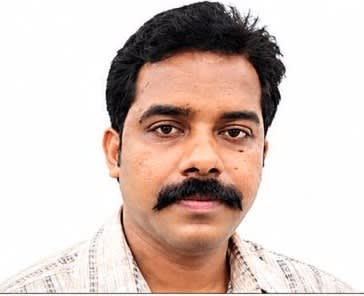
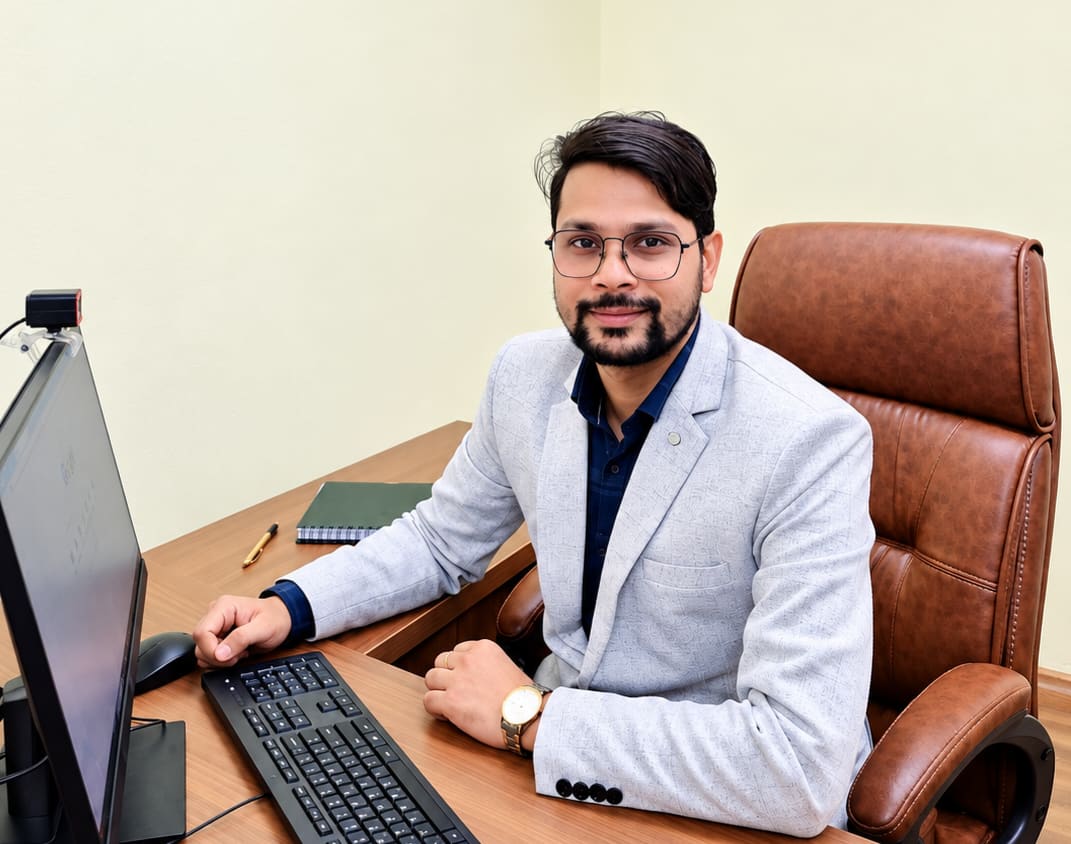
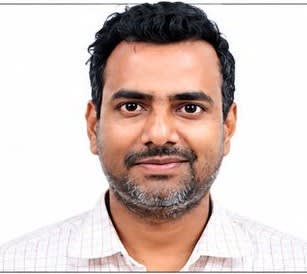
HOD
Dear Students and Parents,
Welcome to the Department of Mechanical Engineering at Government Polytechnic Purnea. Mechanical Engineering is a cornerstone of technological advancement, driving innovation in manufacturing, automation, energy systems, robotics, transportation, and industrial development. Our department is committed to providing quality technical education that integrates fundamental engineering principles with practical skills and hands-on experience.
We strive to create a learning environment where students develop technical competence, analytical thinking, creativity, teamwork, and professional ethics. Through workshop practice, laboratory experiments, technical projects, and exposure to emerging technologies, we encourage students to transform theoretical knowledge into practical engineering solutions.
I encourage every student to remain curious, work with dedication, learn from practical experiences, and uphold the values of discipline, safety, and lifelong learning. With the collective efforts of our faculty, staff, and students, we aim to build a department that promotes innovation, technical excellence, and professional growth.
Let us design, build, and innovate for a better and more sustainable future.
Department Vision
To develop technically competent, ethically responsible, and industry-ready diploma mechanical engineering graduates with practical skills, effective communication ability, entrepreneurial orientation, and exposure to emerging technologies for sustainable societal development.
Department Mission
DM1: To impart strong fundamentals of mechanical engineering through outcome-based teaching–learning processes and industry-relevant curriculum.
DM2: To develop practical skills, problem-solving ability, and professional competence through laboratories, workshops, projects, and industrial exposure.
DM3: To nurture ethical values, safety consciousness, communication skills, entrepreneurship, and lifelong learning for sustainable career growth.
PO | Programme Outcome | Description |
PO1 | Basic and Discipline-Specific Knowledge | Apply knowledge of basic mathematics, science, engineering fundamentals and engineering specialization to solve engineering problems. |
PO2 | Problem Analysis | Identify and analyse well-defined engineering problems using codified standard methods. |
PO3 | Design/Development of Solutions | Design solutions for well-defined technical problems and assist in designing system components or processes to meet specified needs. |
PO4 | Engineering Tools, Experimentation and Testing | Apply modern engineering tools and appropriate techniques to conduct standard tests and measurements. |
PO5 | Engineering Practices for Society, Sustainability and Environment | Apply appropriate technology considering societal needs, sustainability, environmental protection and ethical practices. |
PO6 | Project Management | Apply engineering management principles individually, as a team member or leader, to manage projects and communicate effectively. |
PO7 | Lifelong Learning | Identify individual learning needs and continuously update knowledge and skills in response to technological advancements. |
PEO1. Graduates will apply fundamental mechanical engineering knowledge to solve routine engineering problems in manufacturing, production, and maintenance sectors.
PEO2. Graduates will function effectively as technicians, supervisors, or junior engineers with professional ethics, safety awareness, and effective communication skills.
PEO3. Graduates will pursue higher education, skill development, entrepreneurship, or lifelong learning to adapt to emerging technologies and industrial needs.
PSO1. Apply knowledge of manufacturing, thermal, fluid, and maintenance engineering to operate, inspect, and maintain mechanical systems safely and efficiently.
PSO2. Prepare engineering drawings, assist in basic design and analysis, and use modern engineering tools and emerging technologies for engineering applications.
[Placeholder] The department's brochure, magazine and newsletter will be uploaded here. Attach a PDF using the file field on this section from the admin panel.
| S No. | Registration Number | Student Name | Registration Year |
|---|---|---|---|
| 1. | 311192524058 | MOHAMMAD SHAKIB ALAM | 2025 |
| 2. | 311192525001 | ARYAN KUMAR | 2025 |
| 3. | 311192525002 | ABHAY KUMAR AYUSH | 2025 |
| 4. | 311192525003 | PRITAM KUMAR | 2025 |
| 5. | 311192525004 | AADARSH KUMAR | 2025 |
| 6. | 311192525005 | RAMAN KUMAR | 2025 |
| 7. | 311192525006 | MITHUN KUMAR | 2025 |
| 8. | 311192525007 | ANIKET RAJ | 2025 |
| 9. | 311192525008 | PURUSOTAM KUMAR | 2025 |
| 10. | 311192525009 | MAHESH KUMAR | 2025 |
| 11. | 311192525011 | NITISH KUMAR | 2025 |
| 12. | 311192525012 | KRISH KUMAR | 2025 |
| 13. | 311192525013 | ANKIT KUMAR | 2025 |
| 14. | 311192525014 | SUDARSHAN KUMAR | 2025 |
| 15. | 311192525018 | ADITYA RAJ | 2025 |
| 16. | 311192525019 | GAURAV KUMAR | 2025 |
| 17. | 311192525020 | PRINS KUMAR | 2025 |
| 18. | 311192525022 | BABUL KUMAR | 2025 |
| 19. | 311192525023 | ABHISHEK KUMAR | 2025 |
| 20. | 311192525024 | ANJALI KUMARI | 2025 |
| 21. | 311192525026 | AYUSH KUMAR | 2025 |
| 22. | 311192525028 | PRITY KUMARI | 2025 |
| 23. | 311192525029 | RAHUL RAJ | 2025 |
| 24. | 311192525031 | ABHISHEK KUMAR | 2025 |
| 25. | 311192525032 | AMIT KUAMR | 2025 |
| 26. | 311192525033 | ROHIT RAJ | 2025 |
| 27. | 311192525035 | RAKSHIT RAJ | 2025 |
| 28. | 311192525036 | SUMAN ROY | 2025 |
| 29. | 311192525038 | AYUSH KUMAR | 2025 |
| 30. | 311192525039 | LADDU KUMAR | 2025 |
| 31. | 311192525040 | AVINASH KUMAR | 2025 |
| 32. | 311192525042 | SATYAM RAJ | 2025 |
| 33. | 311192525043 | NAVIN KUMAR | 2025 |
| 34. | 311192525044 | SANU SHEKHAR | 2025 |
| 35. | 311192525045 | ROHIT KUMAR | 2025 |
| 36. | 311192525046 | MD MAHTAB | 2025 |
| 37. | 311192525048 | TANYA SINGH | 2025 |
| 38. | 311192525049 | PREMKISHOR RAJ | 2025 |
| 39. | 311192525052 | PRASHANT RANJAN | 2025 |
| 40. | 311192525054 | HARSH KUMAR | 2025 |
| 41. | 311192525055 | MAYANK KUMAR | 2025 |
| 42. | 311192525058 | HIMANSHU KUMAR | 2025 |
| 43. | 311192525059 | SURAJ KUMAR | 2025 |
| 44. | 311192525060 | AMAN KUMAR | 2025 |
| 45. | 311192525061 | BHARGAV RANJAN JHA | 2025 |
| 46. | 311192525062 | AYUSH KUMAR | 2025 |
| 47. | 311192525063 | RITIK SINGH | 2025 |
| 48. | 311192525303 | ARUSHI KUMARI | 2025 |
[Placeholder] Details of ongoing research projects, publications and consultancy work undertaken by the department will be listed here.
[Placeholder] The department's mentor-mentee list and student support system details will be listed here.
Warm Regards,

Prof. Rajeev Kumar
HOD, Mechanical Engineering