The Electrical Engineering Department develops competent, ethical, industry-ready diploma engineers through OBE-based education. With qualified faculty, modern laboratories, practical learning, internships, field and grid visits, projects, Industry 4.0 exposure, and a Robotics and Drone Technology Centre of Excellence, it promotes employability, innovation, sustainability, and lifelong learning.
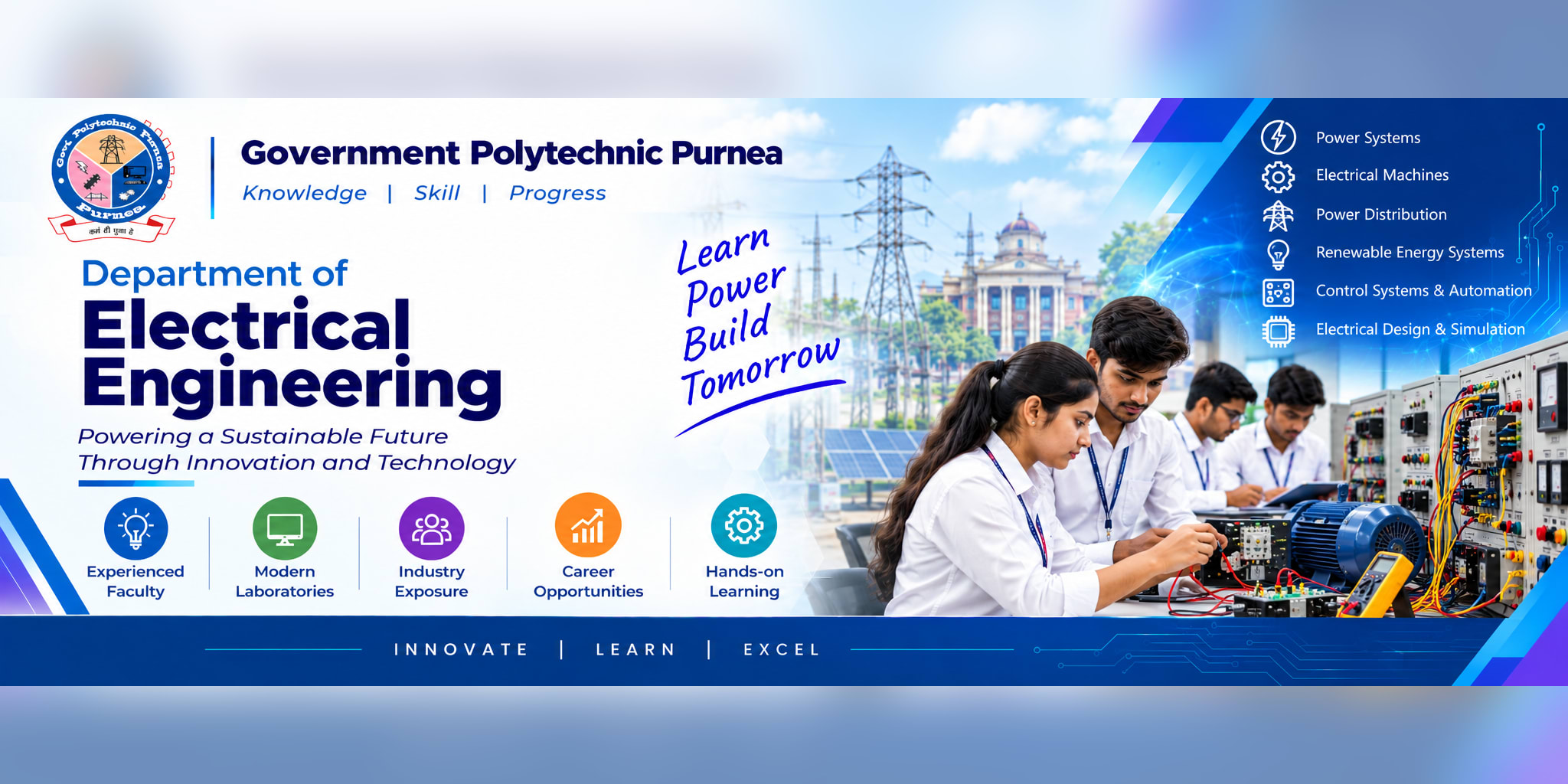
1. Department Overview
The Department of Electrical Engineering, Government Polytechnic Purnea is committed to developing competent, ethical, innovative, and industry-ready diploma electrical engineers through a student-centric, Outcome-Based Education (OBE) framework aligned with NBA quality practices. With an approved intake capacity of 60 students, the department provides a structured learning environment supported by well-qualified and experienced faculty, laboratories, practical-oriented curriculum, industrial exposure, projects, internships, field visits, and continuous assessment.
2. Curriculum and Outcome-Based Education
The department follows the SBTE Bihar curriculum, integrating classroom instruction, laboratory learning, term work, self-learning, MOOCs, projects, internships, and industrial exposure. The curriculum covers electrical circuits, measurements and instrumentation, electrical machines, transformers, power generation, transmission and distribution, power electronics, microprocessors and microcontrollers, control systems, PLC, electrical software, electrical installation, testing and commissioning, and utilization of electrical energy.
The curriculum also provides opportunities for emerging areas including Artificial Intelligence, Drone Technology, Electric Vehicles, Industrial Automation and Control, IoT, and Robotics. These provisions support multidisciplinary learning and prepare students for changing industrial requirements.
3. Bloom’s Taxonomy and Learning Outcomes
Teaching–learning practices are designed around Course Outcomes (COs), Programme Outcomes (POs), and Programme Specific Outcomes (PSOs). Bloom’s Taxonomy is used to progressively develop students from Remembering and Understanding fundamental concepts to Applying, Analysing, Evaluating, and Creating engineering solutions. Laboratory experiments, problem-based learning, assignments, seminars, mini-projects, industrial visits, and major projects provide opportunities to demonstrate higher-order learning and practical competency.
4. Industry 4.0 and Emerging Technologies
The department promotes Industry 4.0 readiness through digital technologies, automation, programming, simulation, control, IoT, robotics, AI, and data-driven engineering applications. Students are exposed to PLC, MATLAB/Simulink, microcontrollers, power electronics, automation, electric mobility, Robotics, and Drone Technology. The Centre of Excellence in Robotics and Drone Technology provides a platform for experiential learning, innovation, prototyping, project development, and exposure to emerging technologies.
5. Laboratories and Practical Learning
Practical education is a major component of the department. Students undertake hands-on learning in electrical machines, power electronics, control systems and PLC, microprocessors and microcontrollers, measurements, electrical software, MATLAB, electrical installations, power systems, and renewable-energy-related applications. Practical activities strengthen the ability to operate, test, analyse, maintain, and troubleshoot electrical systems.
6. Internship, Industrial Exposure and Field Visits
The department emphasizes learning beyond the classroom through summer internships, industrial training, field visits, technical visits, and exposure to electrical utilities and industrial installations. Students gain practical understanding of generation, transmission, distribution, protection, electrical machines, substations, transformers, switchgear, installation, testing, and commissioning.
Grid and power-system visits provide first-hand exposure to substations, transformers, switchgear, protection systems, control equipment, transmission and distribution networks, and electrical safety practices. Such activities bridge the gap between theoretical learning and professional engineering practice.
7. Projects, Innovation and Entrepreneurship
Students are encouraged to undertake mini-projects, major projects, seminars, technical activities, and interdisciplinary projects addressing practical industrial and societal problems. Major projects enable students to apply electrical engineering knowledge, engineering software, modern tools, sustainability concepts, and emerging technologies. Entrepreneurship and start-up orientation further encourage innovation and self-employment.
8. Sustainable Development and Social Responsibility
The department promotes energy efficiency, renewable energy, electric mobility, electrical safety, environmental consciousness, and sustainable engineering practices. Students are encouraged to consider energy conservation, responsible resource utilization, safety, and societal needs while developing engineering solutions, thereby connecting technical education with sustainable development.
9. Employability and Placement Orientation
The department focuses on employability through technical skill development, practical training, communication skills, professional ethics, industrial exposure, internships, project work, and placement-oriented preparation. Students develop competencies required for roles such as technicians, supervisors, maintenance professionals, electrical installation and testing personnel, and junior technical professionals, while also being encouraged towards higher education, entrepreneurship, and lifelong learning.
10. NBA-Oriented Continuous Improvement
The department follows a systematic OBE cycle: Curriculum → CO Formulation → Teaching–Learning → Assessment → CO Attainment → PO/PSO Attainment → Stakeholder Feedback → Corrective Action → Continuous Improvement. Internal and external assessments, laboratory performance, term work, projects, internships, seminars, industrial exposure, and stakeholder feedback support continuous improvement of teaching–learning processes and student outcomes.
HOD
[Placeholder] Dear Students,
A warm welcome to the Department of Electrical Engineering. We are committed to providing you with strong fundamentals, practical exposure and the guidance you need to succeed.
Replace this with the HOD's real message in Admin → Departments → Electrical Engineering → HOD's message.
Warm Regards,
Prof. Bal Krishna
HOD, Electrical Engineering
Programme Vision
To develop competent, ethical, innovative, and industry-ready Diploma Electrical Engineers with strong technical fundamentals, practical skills, digital competence, and sustainable engineering capabilities to address evolving industrial and societal needs through outcome-based education and emerging technologies.
Programme Mission
PM1 – Outcome-Based Technical Excellence: To impart strong theoretical and practical knowledge in electrical engineering through outcome-based teaching–learning, modern laboratories, experiential learning, and industry-relevant curriculum.
PM2 – Industry Readiness & Employability: To develop practical competency, problem-solving ability, engineering tool proficiency, safety consciousness, and professional skills through laboratory work, projects, internships, industrial exposure, and field-based learning.
PM3 – Innovation & Emerging Technologies: To foster innovation and technological competence through the Centre of Excellence in Robotics and Drone Technology, along with exposure to renewable energy, electric mobility, power electronics, automation, and digital technologies.
PM4 – Ethics, Sustainability & Lifelong Learning: To nurture professional ethics, electrical safety, teamwork, communication, leadership, entrepreneurship, sustainability, and lifelong learning for responsible professional practice and continuous career development.
Programme Educational Objectives (PEOs)
PEO1 – Technical Competence: Graduates will apply electrical engineering fundamentals and practical knowledge to install, operate, test, maintain, and troubleshoot electrical systems and equipment.
PEO2 – Industry Readiness: Graduates will perform effectively as technicians, supervisors, or junior technical professionals, demonstrating practical skills, safety awareness, engineering-tool proficiency, communication, and professional ethics.
PEO3 – Innovation & Emerging Technology: Graduates will apply innovative and sustainable approaches and adapt to emerging technologies, particularly through Robotics and Drone Technology, to address industrial and societal needs.
PEO4 – Professional Growth: Graduates will pursue higher education, entrepreneurship, skill development, and lifelong learning, demonstrating adaptability, teamwork, leadership, and social responsibility.
PO | Programme Outcome | Description |
PO1 | Basic and Discipline-Specific Knowledge | Apply knowledge of basic mathematics, science, engineering fundamentals and engineering specialization to solve engineering problems. |
PO2 | Problem Analysis | Identify and analyse well-defined engineering problems using codified standard methods. |
PO3 | Design/Development of Solutions | Design solutions for well-defined technical problems and assist in designing system components or processes to meet specified needs. |
PO4 | Engineering Tools, Experimentation and Testing | Apply modern engineering tools and appropriate techniques to conduct standard tests and measurements. |
PO5 | Engineering Practices for Society, Sustainability and Environment | Apply appropriate technology considering societal needs, sustainability, environmental protection and ethical practices. |
PO6 | Project Management | Apply engineering management principles individually, as a team member or leader, to manage projects and communicate effectively. |
PO7 | Lifelong Learning | Identify individual learning needs and continuously update knowledge and skills in response to technological advancements. |
Programme Specific Outcomes (PSOs)
PSO1 – Electrical Systems, Automation & Industrial Competence: Apply electrical engineering principles, modern engineering tools, and practical skills to analyse, operate, test, install, maintain, and troubleshoot electrical machines, power systems, power electronics, control and automation systems, ensuring safe, reliable, and efficient industrial applications.
PSO2 – Smart, Sustainable & Emerging Technology Solutions: Develop and implement technology-enabled solutions by integrating electrical engineering knowledge with energy efficiency, renewable energy, electric mobility, and emerging technologies, particularly through the Centre of Excellence in Robotics and Drone Technology, addressing industrial and societal needs sustainably.
[Placeholder] The department's brochure, magazine and newsletter will be uploaded here. Attach a PDF using the file field on this section from the admin panel.
[Placeholder] Student achievements, activities and association details for this department will be listed here.
| S No. | Registration Number | Student Name | Registration Year |
|---|---|---|---|
| 1. | SAMPLE-EE-2023-001 | Sample Student ASample | 2023 |
| 2. | SAMPLE-EE-2023-002 | Sample Student BSample | 2023 |
[Placeholder] Details of ongoing research projects, publications and consultancy work undertaken by the department will be listed here.
[Placeholder] Details of the department's classrooms, laboratories, equipment and other infrastructure will be listed here.
[Placeholder] The department's mentor-mentee list and student support system details will be listed here.